Children's Literature: "This is a delightful tale for everyone who loves the fantasy that even a common girl can become a princess. "
Monday, April 28, 2008
Princess Academy by Shannon Hale
Children's Literature: "This is a delightful tale for everyone who loves the fantasy that even a common girl can become a princess. "
Sunday, April 27, 2008
Monster by Walter Dean Myers
1. Bibliography:
Myers, Walter Dean. 1999. Monster. New York: HarperTempest. ISBN: 9780064407311
2. Summary:
Steve Harmon is only sixteen, but he is on trial for felony murder. Told through film format, Steve takes the reader though his trial with flashbacks to his life before going to jail. Steve is an average young man who makes a few choices that lead him to either being in the wrong place at the wrong time or participating in a heinous crime, depending on whether you believe the prosecution or the defense. The "film" shows Steve's day to day life in prison, his trial, and the eventual outcome of the trial.
3. Analysis:
This is an amazing book for so many reasons. First, the set-up is different, which grabs the readers attention. Its format is that of a film, so the story is told from a camera's point of view with film direction added to the narrative. Inside the action are glimpses of the narrator's thoughts through what appear to be journal entries. Lower readers will love the book because a lot of side elements like details on setting or extraneous information is left out, leaving just the pertinent information of the story. Therefore lower readers will not waste precious energy struggling to read extra information that enthralls faster readers but boggles down reluctant readers.
Second is the subject matter, which is a sixteen-year-old African-American boy on trial for murder. Because of his age, younger readers can relate to this thought process and feelings. Because the crime involved acquaintances of Steve, students can relate to the idea of friends getting them into trouble. Myers shows how fair-weathered friends will turn on one another to benefit themselves as Bobo does in the story. Because students can relate to the topic so much, it can be related to their own lives and be a way to not only communicate with the young adults but also give some advice without lecturing...let the book speak to them.
The third is the lack of detail. Myers leaves a lot of detail to the reader's imagination. Steve writes, "I hate, hate, hate this place," but he never tells us why. Readers are allowed to let their imaginations and prior knowledge/hearsay of jail to influence what could make Steve hate jail. Myers also has Steve say,"I feel terrible. My stomach is gassy and bloated. I still can't go to the bathroom in front of everyone." Although the sentences are short and simple, it gives the reader insight that even the most ordinary of daily events is not the same in jail. (Plus, young adult boy readers love anything about body functions!)
4. Reviews:
School Libary Journal--"Monster is a must purchase for all middle and high school libraries. English teachers should be encouraged to use this audiobook as a possible writing prompt or as an introduction to readers' theater."-Lynda N. Short Copyright 2000 Cahners Business.
Children's Literature--"This is a powerful, intense, thought-provoking story. It is great for discussions about the judicial system, pre-judging, self-perception, parent-child relationships and our prison system."
5. Connections:
I use literature circles in my classroom, and I believe this would be a great book for literature circle. Those kids who hate long books or choose books simply based on length would love the style and set-up of the book while still making me happy by reading a great book.
I think it would also be a great book to read as the book club book through the school library. I think the book has so many aspects for discussion that it shouldn't be limited to one subject area. I think it's also a book that kids should be able to bring out the topics that interest them most because there are so many: parent-child relationship, jail, making good choices, law and trials, friends, and many more.
(In fact, I read this book during silent reading time in my classroom, and I had three or four kids put their names down to read it when I finished.)
Monday, April 7, 2008
Joan of Arc by Diane Stanley
Trouble Don't Last by Shelley Pearsall
Pearsall, Shelley. 2002. Trouble Don't Last. New York: Yearling. ISBN: 9780440418115
2. Summary:
Samuel is an eleven-year-old slave. He was born into slavery, but Old Harrison, an old slave on the same farm as Samuel, grabs him one night and runs with Samuel towards freedom. Throughout the book, the reader travels on a journey to freedom with the two characters where they meet with unusual characters, treacherous adventures, and ultimate reward.
3. Analysis:
This book is capturing in many ways. I had to finish it in one day because I had to find out what happened to Samuel and Old Harrison. First, the author sets an authentic setting with wonderful dialect. Conversations with comments like," Now, let's git them hogs fed 'fore they start chewin up the walls," create the southern feel and colloquialisms.
Second, the vivid descriptions of the interaction between Samuel and the other slaves and Mas'er Hackler and his family create a stirring in the reader to want to do something to help Samuel. Anger swells as as Mas Seth trips Samuel, causing him to break a dish and creating an uproar in the house. The author creates a sense of urgency that Samuel must escape and thankfully he does. Another way the author urges the reader to take up the cause of freedom is to describe from a young boy's perspective the wounds on Old Harrison's back. "I had seen them a hundred times, and seeing them always brought the snake twisting back around my throat. I couldn't do a thing but look again. The terrible stripes tore back and forth like the jagged scars that lightning makes when it splits through the bark of trees." Although brief, the description leaves the reader feeling like Samuel did--"Seeing them just made me feel weak all over and sick."
On the journey, the author keeps the story lined up with historical evidence. Many of the places like the homes people hid runaways in, the river crossing, and the network of help are all historically accurate. The interesting characters like the widow Lucy Taylor who still saw and talked to her dead husband provide a light note in an otherwise somber journey.
Finally, the author creates a feeling of suspense. The reader is often left wondering if Samuel will face the end result many runaway slaves did: recapture and punishment if not death. The final challenge when Samuel is captured and must finally believe and present himself as free is wonderful. He learned to "walk free" and his courageous act won him not only his freedom but those with him.
The author gives us a fabulous ending, one where Samuel's mom is there waiting for him in freedom and all those involved live happy lives.
4. Reviews:
Kirkus Review: "This succeeds as a suspenseful historical adventure with survival at stake and makes clear that to succeed Harrison and Samuel, as well as others, must never give up even while combating manhunters, bloodhounds, mental illness, disease, hunger, cold, and their own despair."
5. Connections:
This book would be great in an ELA classroom for discussion on dialogue and suspense. It would also serve well either in excerpts or in whole during a lesson on the Underground Railroad or slavery.
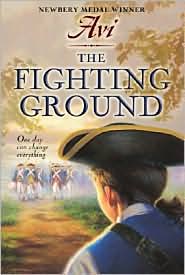
The Fighting Ground by Avi
1. Bibliography:
Avi. 1884. The Fighting Ground. New York: HarperTrophy. ISBN: 9780064401852.
2.Summary:
Jonathan is a thirteen year old boy in America in the year 1778. Although he is young, he leaves his home one day to fight with the American forces. During his one day of service, Jonathan encounters enemy forces, learns about fighting, and a little about how all people are the same inside.
3. Analysis:
The book's set-up of having each section divided by time sets the scene for a young boy's daily routine. However, the day is anything but ordinary. Avi takes the reader for a journey into the personal day of a soldier in the Revolutionary War that is intriguing and very insightful to the daily life of the soldiers.
American students always hear that the soldiers in the American wars were young, but Avi drives the fact home by contrasting Jonathan's enthusiasm with his inept ability to perform. In the opening scene, Jonathan is ready to fight, even daydreaming about it. "His father's flintlock musket leaned against a stump. The cartridge box and powder horn were also there. The gun was primed, ready to be used. Jonathan knew how." These sentences show how Jonathan had been planning to help fight in the war and his confidence that he was equipped to fight. However, a few hours later, this confidence fades as he is "unsteady" and fails to load his gun quickly and accurately, revealing how most American boys were ill-prepared to fight.
American textbooks often idealize the American side of the war, but Avi gives a balanced approach. He shows the commander of the group to be a coward. He walks by Jonathan and does not really help. He only goes to the house to defeat the enemy after Jonathan heroically escapes with the young boy. He also shows the softer side of the enemy forces by having them not kill Jonathan and feed him instead.
In fact, it is the interaction with Jonathan with the Hessians that is the most compelling part of the book. Avi shows Jonathan's terror in the situation by not translating the Hessians' conversations. As the Hessians speak rapidly at Jonathan, the reader too feels confused and isolated. It is not until the end of the book that the reader realizes that the Hessians mean Jonathan no harm and want to "Let him go!" This interaction--Jonathan's saving the Hessians and their want to let him go free--show the most important theme of the book: that we are all human no matter what side of a war we are on.
4. Reviews:
Notable Children's Books of 1984 (ALA)
1984 Best Books for Young Adults (ALA)Notable
1984 Children's Trade Books in Social Studies (NCSS/CBC)
1984 Scott O'Dell Award for Historical Fiction for Children
5. Connections;
This book would be a great extended lesson in a history class. Because it's a quick read, it would be easy to read a little each day or to assign it as an extension homework assignment.
Monday, March 17, 2008
Icebergs and Glaciers by Seymour Simon
1. Bibliography:
Simon, Seymour. 1987. Icebergs and Glaciers. New York: William Morrow and Company, Inc. ISBN: 0688061869
2. Summary:
In this book, Seymour Simon begins with a simple snowflake and ends up with a glacier. Through simple paragraphs and detailed pictures, the reader discovers how a snowflake is one crystal that when joined together with many other snowflakes can create snow, which creates ice, which forms blocks of ice known as glaciers. After learning about the formation, the reader then finds out what happens with a glacier's movement, type, changes.
3. Analysis:
The book is twenty years old. In the last twenty years, much news has been made about global warming and the melting of ice caps and glaciers around the globe. With this new trend, a book written twenty years ago is outdated and archaic. However, this does not render the book totally useless. Its easily understandable text makes the book a great explanation for how glaciers are formed while Its simple sentences like "All glaciers move in both ways" are short sentences designed to keep scientific (and often complex) ideas simple for early students to not only read but also understand.
The pictures are vivid for the 1980s, but today's children are used to bolder and clearer pictures with the technology we have today. However, the choice of keeping the background all white adds to the glacier look as do the block letters, which give the feel of the blocks of ice.
Overall, while the book is clear, well-written, and informative ,the information presented is just outdated. In fact, I checked this book out from the library where I teach, and it's interesting to note that the book has only been checked out twice since 1990 according to the stamps in the back of the book. One of these dates in the last 17 years is the date when I checked it out! Perhaps this is a book that could be revised with today's facts and pictures from our new technology.
4. Reviews:
School Library Journal: "This one would almost be worth adding to collections for the spectacular illustrations alone, but Simon's lively and informative text makes the book even more impressive." Jonathan Betz-Zall, Sno-Isle Regional Library System, Marysville, Wash.
5. Connections:
Because of the book's age, I don't know if it would be currently useful. However, if a class was discussing global warming and glaciers today, it would be interesting to compare it to the knowledge shared in this book to see how things have changed in twenty years.
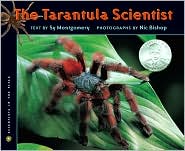
The Tarantula Scientist
1. Bibliography:
Montgomery, Sy. 2004. The Tarantula Scientist. Boston: Houghton Mifflin Company. ISBN: 0618147993
2. Summary:
In this book, Sy Montgomery follows scientist Sam Marshall as he travels to French Guiana's rainforest on a quest to find out more about tarantulas. The book begins with Sam's quest to find the tarantulas, analyze their habits and living conditions, and ends with his return to the lab to study his findings. Readers not only learn about the research involved but also about tarantulas.
3. Analysis:
Sam Marshall is one out of four or five scientists world-wide who study tarantulas, so this book is an important tool for learning more about tarantulas and the study of them. Sy Montgomery 's challenge is to take detailed scientific research and to make it understandable (and interesting) to kids. She systematically does this in a few simple ways. First, the font is fun. It's not typical font for what kids would see as a "science" textbook. Its thin but sometimes crooked letters almost look like spiders' legs, which sets the feel of the book. Second, the difficult words are accompanied by a phonetic spelling so that kids are not daunted by words such as arachnologist ("ar-rack-NAWL-o-gist"). That is a helpful took to a kid who has not clue how to say the word (and spellcheck has no suggestion for its spelling). The third way is that difficult concepts for younger kids like how the animals are divided into kingdoms, which are further divided, are compared to things like separating clothes--fancy from play, etc. This helps kids relate a harder concept to something they do in their own room.
Because the book follows Sam on an expedition into the rainforest and includes many quotes from the scientist himself, the book clearly demonstrates the passion Sam feels, which gets the reader interested as well when he cracks jokes like, "If life gives you worms, make spider bait," as he is trying to entice a spider out of her burrow. When there's a quote from Sam, saying, "She's a regular eight-legged Martha Stewart," the reader laughs and knows exactly what the spider is like, which connects the text to the reader.
Instead of organizing the book in chronological order of Sam's expedition or by topic, the book seems to jump around from telling about the tarantulas, back to the jungle, then to the research, and then to different types of tarantulas. Comprehension of the facts in the book would be aided by better organization. I could see this book being used as a source for a science paper or science fair project, and better organized (and labeled) chapters would aide in finding specific information.
The pictures are fabulous. The photographer, Nic Bishop, captures the tarantulas in their natural habitat. He captured some wonderful shots of the tarantulas shedding their skin and kicking up dirt in anger. These vivid pictures add to the written description of Sam's findings.
4. Reviews:
Kirkus Reviews: "Bishop's phenomenal photos show spiders mating, shedding their skin, even leaping through the air. It's enough to make Miss Muffet fall in love." (Nonfiction. 8-14)
School Library Journal: "Informative, yes, but even more important, this is a vivid look at an enthusiastic scientist energetically and happily at work, both in the field and in the lab, questioning, examining, testing, and making connections. A treat, even for arachnophobes." -Patricia Manning, formerly at Eastchester Public Library, NY Copyright 2004 Reed Business Information.
5. Connections:
This would be a fabulous book to have in a science classroom. The pictures are great visuals to go along with science lessons. Also, since the pictures are all taken in the natural habitat, students would get to see exactly how the spider lives.
Sunday, March 2, 2008
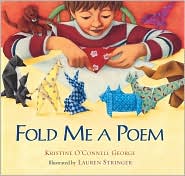
Fold Me a Poem by Kristine O'Connell George
1. Bibliography:
George, Kristine O' Connell. Ill. by Lauren Stringer. 2005. Fold Me a Poem. New York: Harcourt Inc. ISBN: 0152025014
2. Summary:
In this collection of short (some are haiku but not all) poems, Kristine George uses origami foldings as inspiration for poems. A young boy creates origami animals throughout the day. The boy's vivid imaginations takes readers to a place where pieces of paper can become anything a creative mind wishes them to be.
3. Analysis:
The idea of the origami is catchy. I read the book to two five-year-olds. They immediately started talking about how they made origami at school and wanted me to show them how to make all the different animals presented in the story.
The book follows the creator of the origami throughout his day, starting with the rooster who starts the day off and ending with a mystery noise ("Is someone dancing?") while the boy goes to sleep with an origami animal in his hand. Young readers will recognize the daily habits of waking up, taking a bath, and going to sleep as the same things they do. With that recognition, they will also see how creative the boy is with even the most mundane experiences.
My favorite poem is "Tub," but I could not tell you specifically why. I think it is because the lines "I hope these boats will float. The shore is lined with passengers" grab me because the child is so involved with his pretend world that it follows him everywhere just like a good idea or dream that I have will follow me through the day. The first time I read through the book, I thought it to be boring except for this poem. The second and third read caused me to like the book more as I saw past its simplicity to it's creative meaning.
The illustrations are bright and eye-catching. Kids are drawn to bright colors, and these will grab their attention. The background of each page is pretty bland or monotone, which allows the origami creations to really pop and to stand out as the true part of the book. The first time I read it, I barely read the words because I was intrigued by the colorful designs. The pictures also express the idea that people must be involved in creativity and ideas by showing the boy manipulate the "boring" paper into something beautiful and unique.
4. Reviews:
Publishers Weekly:"This unusual poetry volume is a dazzling celebration of imagination." Copyright 2005 Reed Business Information.
Kirkus Review:"There are no step diagrams, so this engrossing collaboration is more a motivator than a teaching resource-but Stringer supplies a list of classic titles for beginners at the end, and (librarians: be warned!) the square, brightly colored end papers make tempting, oh so tempting starter sheets." (Picture book/poetry. 6-9)
5. Connections:
This book would be a great introduction to poetry because the short poems are catchy and easy to imitate. They would not be overwhelming to students. In this module, we've learned that many people are intimidated or bored with poetry, so this is a nonthreatening way to start learning about poems.
It could also be used in an art class as an introduction to origami.
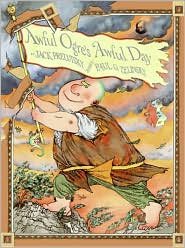
Awful Ogre's Awful Day
1. Bibliography:
Prelutsky, Jack. Ill, by Paul O. Zelinsky. 2001. Awful Ogre's Awful Day. New York: Grennwillow Books. ISBN: 0688077781
2. Summary:
This collection of poems introduce readers to Awful Ogre's world. Through the 18 poems, readers are taken from the beginning to the end of Awful Ogre's awful day. Awful Ogre encounters many situations like dancing, eating, writing a letter, and talking to neighbors that readers themselves experience except his day has an "awful" twist.
3. Analysis:
This book is a hit for boys (and those girls) who love gross stuff! The collection starts with a bang in "Awful Ogre Rises." Readers get a clear mental picture of Awful Ogre who is awakened by his rattle snacks. Lines like "My rats attack me as I rise but scatter when I roar" and "I tickle my piranha who rewards me with a bite" give readers a clear picture of this strange Ogre's life. However, the bizarreness of his morning awakening makes the reader want to turn the page.
The book is cleverly written with phrases like "Scream of Wheat" and "You're truly perfection, demure and petite, just fourteen-foot-four from your head to your feet." The final poem "Awful Ogre's Awful Dream" cleverly contradicts the normal view of a great day by having Ogre end his day with a nightmare where "The sun's an orange circle, and the sky's a brilliant blue. Bees are buzzing busily, and roses show their blooms."
The illustrations for this book definitely add to the book. The pictures accompanying the poem "Awful Ogre's Breakfast" perfectly illustrate the poem. As Awful Ogre feasts on Scream of Wheat, the picture shows an open, screaming mouth inside the bowl as Awful Ogre is smiling happily at his meal. The picture for "Awful Ogre Speaks of Stature" is definitely in touch with the young boy readers as the picture shows Awful Ogre's snot dripping out of his nose onto the small elves and gnomes who are calling him grotesque. Talk about payback!
My three-year-old nephew did not want me to read the book to him. He grabbed it and immediately began talking about the pictures, making up his own story! My seven-year-old niece asked me if she could read it on her own. On the sticky note I gave her, she wrote,"I think he's weird, disgusting, and lazy." (The spelling was changed for the blog!)
4. Reviews:
Publishers Weekly: "Prelutsky uncorks his latest collection of light verse, a divinely wretched celebration of subversity. Every detail of Awful Ogre's day offers possibility for gross-outs, from sunup ("I flick aside the lizard/ Clinging grimly to my chin,/ And now I feel I'm ready/ For my morning to begin") to sundown (a sly swat at Goodnight Moon as Awful Ogre drifts off to sleep with "Good night to furtive spiders/ That lurk in murky wells./ Good night to loathsome vermin/ With nauseating smells")."Copyright 1999 Cahners Business Information.
5. Connections:This book would be a good one to read to the class to get them to enjoy the book. Through out this module, we as students have learned that many people don't enjoy poetry and seem intimidated by it. Reading a fun collection like this is sure to get students, especially boys, engaged in poetry. They may even be inspired to write a poem themselves!
Monday, February 18, 2008
Porch Lies by Patricia C. McKissack
1. Bibliography:
McKissack, Patricia C. 2006. Porch Lies: Tales of Slicksters, Tricksteres, and Other Wily Characters. New York: Schwarz and Wade Books. ISBN: 0375836195
2. Summary:
This collection takes readers to a swing on a porch, where they can listen in on stories similar to those passed down from generations about schemers who sometimes win and who sometimes get what they deserve. McKissack keeps in the oral tradition of the African-American culture in which she grew up listening to porch lies by telling her own porch lies to an eager audience. She explores characters such as Aunt Gran who cons the cons into protecting her property against white supremacists and Mingo Cass who only carries around a 100 dollar bill, keeping him from ever having to "break" it and pay for anything.
3. Analysis:
People of all cultures and races can enjoy and identify with the short stories told in this collection. Although the stories are set in an African-American setting, all readers can relate to family members telling stories, often exaggerated, about days gone by. Although the book is fictional, McKissack addresses civil issues that were prevalent in Southern communities during times of racial segregation and strife. She also adds the hope of many of that time that one day the races would be equal by having the white Mis Crickett ride in the front seat with her black chauffeur.
The colloquialism in the story adds to the southern feel, creating the slower-paced southern small community who would take the time to tell stories on the porch. Diaglogue such as,"See, he aine got it" and "Looka here. Looka here" add to the feel of the small town tone of the stories.
I do agree with one review that McKissack could have made a notation to explain the truth of the social setting of the African-American culture within these "lies." While the stories may be fiction, the inequality in the world, especially for African-Americans, was sadly the norm during the time of the stories, and this sobering truth should be pointed out amid the fun stories.
The illustrator's use of black and white colors only in the pictures provide a striking contrast to the colorful and vibrant personalities of the tricksters highlighted in the stories. Andre Carrilho only adds to the story with his understated pictures, which allow the reader to create the colors from the story and not Carrilho's interpretation of the story.
4. Reviews:
"It would have helped readers unfamiliar with African-American history to have an author's note helping separate the "truth" of these lies that allude to Depression-era African-American and Southern traditions. That aside, they're great fun to read aloud and the tricksters, sharpies, slicksters, and outlaws wink knowingly at the child narrators, and at us foolish humans."-Susan Hepler, formerly at Burgundy Farm Country Day School, Alexandria, VA Copyright 2006 Reed Business Information.
"As McKissack (The Dark-Thirty) opens this treasure chest of tales, she recalls spending summer evenings on her grandparents' front porch in Nashville, where her grandfather and visitors would share spellbinding "porch lies," comically exaggerated stories that often centered on rogues and rascals." Publishers Weekly
5. Connections:
This collection is a great asset in a language arts classroom. The stories can be used to discuss the African-American tradition of passing on stories orally because that was the only means of communication when slavery existed. It can also be used to discuss the difficulties African Americans after the Civil War since the book addresses topics like the Knights who terrorized innocent people like Aunt Gran.
I plan to use this book in my own language arts classroom as examples for my students to write down a story told often in their own families.