Showing posts with label african american poetry. Show all posts

Thursday, April 21, 2011

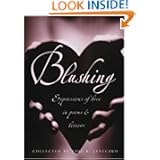
M6 Blushing Expressions of Love in Poems and Letters

Janeczko, Paul B. 2004. Blushing. New York: Orchard Books. ISBN: 0439530563.
     In this collection of poems, Janeczko organizes the poems to follow the rhythm of love: Beginning of Love, In Love, Alone in Love, the End of Love, and Remembering Love. The poets represented range from the past (Shakespeare and Bradstreet) to the current (Angelou and Merwin), representing the timelessness of love and the feelings associated with having and with losing it.


     As Janeczko writes in the introduction, “only the intensity of poetry could convey the intensity of what I was feeling, of what I had experienced” (x). While prose has more words to express the feelings and thoughts of a character, the brevity of poetry often speaks louder. The author chooses the style, the rhythm, and even the length and spacing to express an exact emotion or feeling. Each poem is unique just as each love is unique yet similar.

     The combination of old poems with new ones bridges a gap in poetry and thus in poetry lessons. With the common theme of love, teachers and librarians can pair read a poem by a nineteenth century poet and one from recent years. For example, “Time Does not Bring Relief” by Edna St. Vincent Millay’s powerful final lines and “Separation by W.S. Merwin are written in different time periods but reflect the same sorrow of lost love.

“Time Does not Bring Relief”

And entering with relief some quiet place

Where never fell his foot or shone his face

I say, “There is no memory of him here!”

And so stand stricken, so remembering him.

“Separation”

Your absence has gone through me

Like thread through a needle

Everything I do is stitched with color.


     The book is a beautiful look at love, both the passion and the pain of giving your heart to another. It’s a great resource for a teacher or librarian to have to pull poems for class discussion or analysis. For poetry lovers, reading the book is like reuniting all your old friends (Langston Hughes, John Donne) with your new friends (Angelou and Lady Sono no Omi Ikuha).


Wednesday, February 2, 2011

Keeping the Night Watch by Hope Anita Smith (LS 5663 Review)


Smith, Hope Anita. 2008. Keeping the Night Watch. New York: Henry Holt and Company. ISBN: 9780805072020.

      Thirteen year old C.J. became the man of the house when his father walked out on the family. Now that his father is back, C.J. struggles to find not only his place in the family but also forgiveness for his father, who is doing everything in his power to make amends.


      Told in free verse poetry, this book tells the journey from fall to spring, from hate to forgiveness, and from separation to unity. The simple words are rich with figurative language. C.J. compares the family conversations to baking, his father's eyes to a white flag of surrender, and the family's security to fine bone-china. Although each poem could stand alone, woven together, they tell the story of a healing family. Offsetting the serious nature of forgiving a father who abandoned him, C.J. also describes his crush on Maya and his nervousness when he’s around her. The addition of these poems creates a balanced look at a teenage boy.

     The pictures, illustrated by E.B. Lewis, add fill in the blanks left by the simple words. The most compelling picture is the one for the poem entitled “Showdown at the O.K Corral”, which pictures C.J. and his father face to face, C.J.’s face angry and his father’s face determined. Another picture that speaks volumes accompanies the poem “Light at the end of the Tunnel”, which has a dark tunnel with C.J.’s father at the end in white, symbolizing C.J.’s secret hope that at the end, his father will be there as “our sun rising” (Smith 69).

      To introduce this book, “If You can’t Stand the Heat”, which epitomizes C.J.’s anger is a good place to start.

I am mad.

I am the worst kind of mad.

I don’t yell.

I don’t slam doors.

I don’t throw things.

I’m a pot with a lid on,

I keep all my mad inside.

I just let it stew.

I want Byron to be mad, too,

but he isn’t.

Says he doesn’t want to hold on to mad.

He takes the lid off his pot,

Lets mad go.

Says he wants his family back.

Says he’s glad Daddy’s home.

I’m mad at Daddy,

But it feels like I’m mad at Byron, too.

We’re two different kinds of pots,

Byron and me,

and when it comes to Daddy,

we can’t cook together. (Smith 16)

       Students can analyze the emotion, the simple sentence structure to convey anger, and the cooking metaphors and then compare it to the final poem “Dance with Me” where the family finally comes together when C.J. dances with his father. “We keep our eyes on Him. We dance on our tears” (Smith 73). After reading this poem, students could write in their Jammin’ Journals (journals written in response to music) after listening to the song “Dance with my Father” by Luther Vandross. The journal entries could compare C.J.’s feeling of forgiveness when he dances with his father and the song’s sorrow over his mother no longer being able to dance with his father.